
Resources for Researchers and Clinicians
A variety of government agencies and other organizations offer information, resources, and services for rare disease researchers and clinicians. Click on the accordions below to find a variety of these resources. See also our pages offering resources for early stage investigators and funding opportunities.
Human Subject Research Protocols: If you write it (well), they will come
Regulatory Webinar Series: Presented by Mike Fusakio, PhD, Cincinnati Children's Hospital Medical Center.
So Many Procedures, So Little Time: How to Develop an Effective Schedule of Events
Regulatory Webinar Series: Presented by Mike Fusakio, PhD; Nathan Hawk, BSPS; Samantha Sonoda, MS, CCRA; and Lisa M. Tully, MA, CCRP, all affiliated with Cincinnati Children's Hospital Medical Center.
Single IRB (Institutional Review Board) Presentation & Panel Discussion
Regulatory Webinar Series: Features Nichelle Cobb, PhD, Smart IRB Director at University of Wisconsin-Madison. Panelists include James Cnota MD (Cincinnati Children's), Jeremy Corsmo, MPH (Cincinnati Children's), Pooja Khatri, MD, MSC (University of Cincinnati) and Mike Linke, PhD (University of Cincinnati).

Rare Disease Innovation, Science, and Exploration (RISE) Workshop Series - RISE Workshop 1
The Rare Disease Innovation Hub’s inaugural RISE Workshop, entitled On the RISE: Controls in Rare Disease Clinical Trials for Small and Diminishing Populations, took place on September 3, 2025. The hybrid, public workshop, co-convened by the Duke-Margolis Institute for Health Policy and the U.S. Food and Drug Administration (FDA) Rare Disease Innovation Hub under a cooperative agreement with the FDA, explored some of the unique challenges of conducting clinical trials in rare disease populations, especially for small and diminishing patient populations. FDA and external panelists discussed considerations when choosing a control for rare disease trials, discussed existing and innovative control options internal and external to the trial, and identified ways these controls can be used to generate evidence that supports regulatory decision-making.

Rare Disease Innovation, Science, and Exploration (RISE) Workshop Series - RISE Workshop 2
The Rare Disease Innovation Hub’s second RISE Workshop, entitled Individualized Therapies On The RISE, took place on November 5, 2025. The current drug development paradigm and associated regulations were developed to test single medicines that treat numerous patients, long before the concept of precision medicine became a reality in the form of individualized therapies [e.g., genome editing products and antisense oligonucleotides (ASOs)]. Individualized therapies, for the purposes of this meeting, are defined as therapies tailored to the unique genetic variants of one or a very small number of individuals. While ASOs are not novel, their application as individualized therapy is. The first individualized ASO treatment was administered in 2018 to treat a form of Batten disease, and since then, many more patients with various conditions have since received such treatments. More recently, individualized gene editing therapies have been developed, including one used to treat an infant with CPS1 deficiency. Over recent years, the U.S. Food and Drug Administration (FDA) has developed numerous guidance documents for gene therapies and ASOs, including for individualized ASOs. As individualized ASOs and gene editing products are entering the clinic, it is timely to evaluate whether current regulatory practices are optimal to support the development of individualized therapies.

Rare Disease Innovation, Science, and Exploration (RISE) Workshop Series - RISE Workshop 3
The Rare Disease Innovation Hub’s third RISE Workshop, entitled RISE Together: Data Sharing Across the Rare Disease Ecosystem, took place on March 30, 2026. The workshop explored data sharing as it pertains to informing development and regulatory review for rare disease therapies. The small patient populations and often heterogeneous nature of rare diseases result in a paucity of data, further intensified when multiple sponsors are working to develop medical products for the same disease state. As a result, opportunities for rigorous, high-quality data collection would have a significant impact in this space. There may be opportunities for the rare disease community to support and encourage broader access through the sharing of existing data to inform certain areas of rare disease medical product development including disease progression modeling, endpoint selection, inclusion/exclusion criteria, and safety. Normalizing data sharing could help to inform clinical trial protocols, safety monitoring, and risk-benefit assessments throughout the development and post-marketing processes.
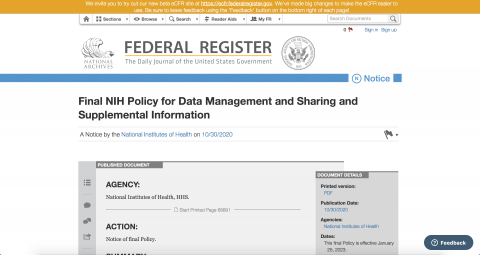
NIH Data Management and Sharing policy
New NIH Policy for Data Management and Sharing that goes into effect January 25, 2023 and replaces the existing 2003 NIH Data Sharing Policy. Updated to keep pace with scientific and technological advancements and emphasizes the NIH’s commitment to data management and sharing.
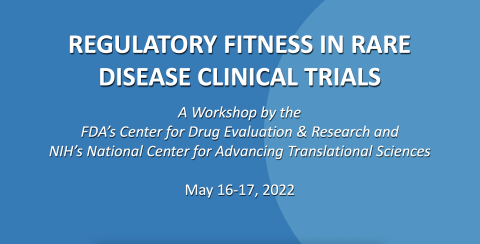
FDA CDER & NIH NCATS Regulatory Fitness in Rare Disease Clinical Trials Workshop
On May 16 and 17, 2022, the FDA’s Center for Drug Evaluation and Research (CDER) and NIH’s National Center for Advancing Translational Sciences (NCATS) hosted a jointly sponsored virtual workshop on regulatory fitness in rare disease clinical trials.