When will a person with amyotrophic lateral sclerosis (ALS) begin to experience symptoms? Researchers have discovered new biomarkers that can help predict the arrival of symptoms, allowing early intervention that could prevent permanent motor damage.
The study, supported in part by data from the Clinical Research in ALS and Related Disorders for Therapeutic Development (CReATe) Consortium, identifies levels of blood proteins that may shift in the months to years before ALS symptoms emerge.
Targeting the Pre-Symptomatic Phase
Two decades ago, researchers began to collect data and biological samples that would lead to these findings. Growing evidence suggested that ALS has a pre-symptomatic phase, where the disease is active but not yet showing signs and symptoms. However, this was difficult to study, as it could take years for patients to receive a diagnosis, even after symptom onset.
At the time, dozens of clinical trials had already been completed—yet none had resulted in effective treatments. A likely roadblock was the delayed timing of these experimental treatments, which weren’t administered until well into the course of disease. And with a neurodegenerative disease like ALS, every day counts—over time, patients experience motor neuron damage that is irreversible.
But what if individuals with ALS could be treated soon after symptoms emerge, slowing or reversing the progression? Even better—what if they could be treated before those symptoms begin? Could the disease be prevented from showing up at all?
Following Genetic Risk Over Time
In 2007, researchers launched a study to learn more about the pre-symptomatic phase, the onset, and progression of ALS. Since 2010, the study has been expanded to also study the pre-symptomatic phase of frontotemporal dementia (FTD) associated with ALS. The team recruited healthy participants who were at genetic risk for developing ALS, meaning that two or more of their biological relatives had ALS or a mix of ALS and FTD.
The study—Pre-symptomatic Familial ALS (Pre-fALS)—follows these participants over time, collecting data and biological samples for nearly 20 years. Researchers compared the findings with data from healthy controls and ALS patients, which were partially collected from the CReATe-funded study “Phenotype, Genotype & Biomarkers in ALS and Related Disorders (PGB1).”
In 2017, analysis of Pre-fALS data revealed the first risk biomarker—neurofilament light chain (NfL), a structural protein in neurons. In ten study participants who developed ALS during study follow-up and are referred to in the study as “phenoconverters,” NfL had spiked in the blood months before ALS symptoms began. Most of these individuals had specific mutations in the SOD1 gene that are associated with an especially aggressive form of ALS.
With this pivotal discovery, researchers were able to partner with a company called Biogen to design ATLAS, the first clinical trial for ALS prevention. Currently ongoing, the trial is testing whether starting treatment with tofersen—a drug approved for symptomatic SOD1-ALS—could delay or even prevent the onset of ALS symptoms among presymptomatic carriers of SOD1 mutations that are highly penetrant and associated with rapidly progressive disease.
Searching for More Risk Biomarkers
In patients with SOD1 mutations associated with fast-progressing ALS, NfL helps predict symptom onset by reflecting how quickly axons—long, thin parts of nerve cells that send electrical signals—are damaged or dying off. But what about individuals with other, less aggressive genetic variants, where NfL alone may not be sufficient as a prediction tool?
Researchers knew that if future disease prevention trials were going to be successful, they would need to find more risk biomarkers. So, they set out to map the trajectory of an array of protein biomarkers across the course of ALS disease progression.
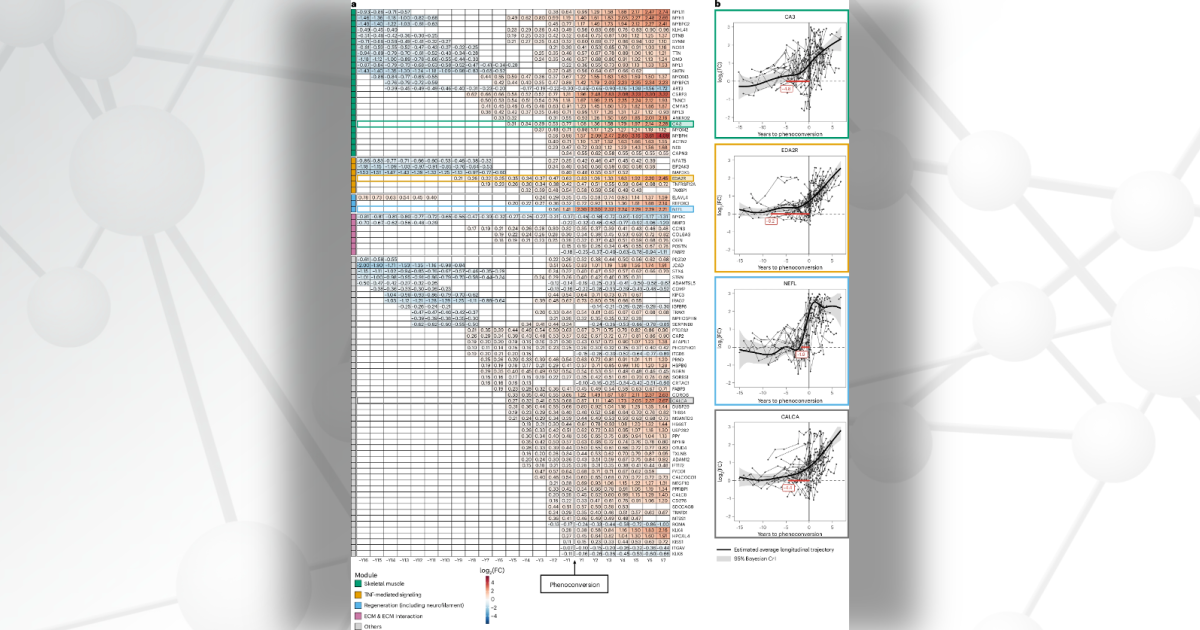
First, the team used a high-throughput proteomic approach called Olink to quantify the levels of thousands of proteins in 516 longitudinally collected plasma samples from 137 study participants. Then, they used bioinformatic techniques such as machine learning to test how different combinations of proteins could predict symptom onset.
“Our latest work identifies a much larger number of proteins—more than just NfL—whose concentrations changed pre-symptomatically,” says Michael Benatar, MD, PhD, professor of neurology and public health sciences at the University of Miami, principal investigator of CReATe, and co-principal investigator of Pre-fALS. “A subset of them—which included NfL— when taken together showed earlier changes compared with NfL alone, and in carriers of a wide range of pathogenic variants.”
With data from this panel of 19 key proteins, researchers built predictive models that could estimate a phenoconverter’s symptom onset within less than two years of the actual time they showed signs of ALS.
“This represents a critically important step towards clinical trial readiness with regards to ALS prevention trials in other genetically at-risk populations,” says Joanne Wuu, ScM, research associate professor of neurology and public health sciences at the University of Miami and co-principal investigator of Pre-fALS.
Next, researchers will apply other omics techniques to blood and cerebrospinal fluid samples, continuing the search for additional biomarkers that can help predict the risk of ALS.