Each month, we share summaries of recent Rare Diseases Clinical Research Network (RDCRN) grant-funded publications. Catch up on the latest RDCRN research below.
Jump to:
- Consortium of Eosinophilic Gastrointestinal Disease Researchers (CEGIR)
- Spastic Paraplegia Centers of Excellence Research Network (SP-CERN)
Listen to these summaries on the Rare Research Report podcast.
Consortium of Eosinophilic Gastrointestinal Disease Researchers (CEGIR)
Investigating the Use of Dupilumab to Improve Outcomes for Individuals with Eosinophilic Gastritis
Eosinophilic gastritis (EoG) is a rare immune disease that occurs when white blood cells called eosinophils build up in the digestive tract in association with injury and inflammation. For individuals with EoG, this makes eating difficult or even impossible. Heartburn, nausea, vomiting, weight loss, and bloating can be painful and lifelong. However, there are currently no FDA-approved medications for EoG.
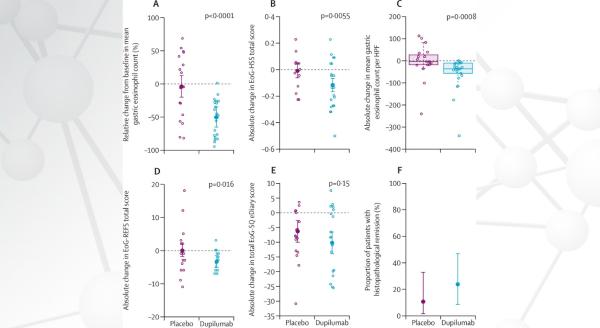
In this study, researchers investigated the use of dupilumab to improve outcomes for individuals with EoG. Forty-one participants with EoG were given dupilumab or a placebo for 12 weeks. Then, researchers evaluated outcomes, including eosinophil counts in the stomach.
Results showed that dupilumab improved the primary outcome and several secondary outcomes, including gastric eosinophil counts, histopathologic and endoscopic abnormalities, and transcriptomic biomarkers compared to the placebo group. Authors note that these findings provide a framework for larger-scale studies and improve understanding of the mechanisms of inflammation in EoG.
Gonsalves NP, Dellon ES, Kliewer KL, Shoda T, Yearout R, Aceves SS, Arva NC, Besse JA, Caldwell JM, Chehade M, Coleman A, Collins MH, Anvari S, Falk GW, Gupta SK, Hiremath G, Katzka DA, Khoury P, Leung J, Menard-Katcher C, Menard-Katcher P, Peterson KA, Pletneva MA, Spergel AKR, Spergel JM, Vaysman T, Wechsler JB, Wright BL, Yang GY, Zhang X, Zhou M, Bansal A, Raphael BP, Radwan A, Maloney J, Martin A, Deniz Y, Furuta GT, Martin LJ, Rothenberg ME; Consortium of Eosinophilic Gastrointestinal Disease Researchers (CEGIR) Investigators. Dupilumab versus placebo in adults and adolescents with eosinophilic gastritis (DEGAS): a double-blind, placebo-controlled, phase 2, multicentre, randomised controlled trial. Lancet Gastroenterol Hepatol. 2026 Jun 23:S2468-1253(26)00116-0. doi: 10.1016/S2468-1253(26)00116-0. Epub ahead of print. PMID: 42341804; PMCID: PMC13308152.
Spastic Paraplegia Centers of Excellence Research Network (SP-CERN)
Investigating Genotype–Phenotype Correlations and Natural History of Early-Onset SPG4
Hereditary spastic paraplegia type 4 (SPG4) is the most common form of hereditary spastic paraplegia, a large group of inherited disorders that affect the long nerve pathways carrying movement signals from the brain down the spinal cord to the legs. SPG4 is caused by changes in the SPAST gene. People with SPG4 commonly experience difficulty walking due to muscle weakness and spasticity (muscle rigidity) in the legs, as well as hyperreflexia (overactive bodily reflexes), urinary urgency or bladder dysfunction, and mild loss of vibration sense in the feet. Symptoms and time of disease onset can be very different from person to person, even within the same family. Not much is known about the natural history of SPG4, making it difficult to conduct clinical trials and find new therapies.
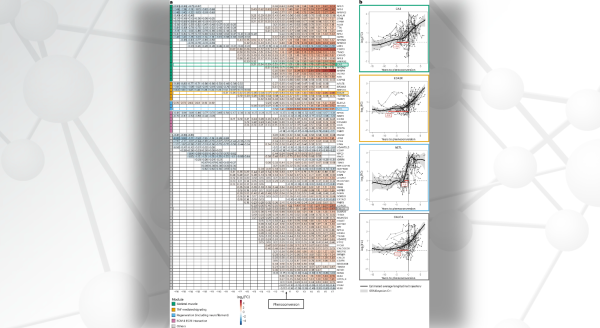
In this study, researchers investigated genotype–phenotype correlations and the natural history of early-onset SPG4. The team used deep phenotyping to analyze 206 patients with genetically confirmed SPG4 from seven international centers. Researchers also studied data from an additional 146 patients from previous studies.
Results provide the most detailed natural history of SPG4 to date, creating a framework that links specific genetic variants to different clinical trajectories. Authors note that these findings can improve care and optimize clinical trial design for SPG4.
Alecu JE, Schierbaum LM, Tam A, Quiroz V, Bernardi K, Yang K, Roller JR, Döbler-Neumann M, Rattay TW, González-Salazar C, Zehr EA, Skorohodovs D, Rong J, Carty S, Battaglia N, Lee S, Moon J, Christie M, Roll-Mecak A, França MC Jr, Schüle R, Schöls LJ, Ebrahimi-Fakhari D. Genotype-structure-phenotype correlations define divergent natural history in early-onset spastic paraplegia type 4. Brain. 2026 May 5:awag150. doi: 10.1093/brain/awag150. Epub ahead of print. PMID: 42083457.
The Rare Diseases Clinical Research Network (RDCRN) is funded by the National Institutes of Health (NIH) and led by the National Center for Advancing Translational Sciences (NCATS) through its Division of Rare Diseases Research Innovation (DRDRI). Now in its fifth five-year funding cycle, RDCRN is a partnership with funding and programmatic support provided by Institutes, Centers, and Offices across NIH, including the National Institute of Neurological Disorders and Stroke, the National Institute of Allergy and Infectious Diseases, the National Institute of Diabetes and Digestive and Kidney Diseases, the Eunice Kennedy Shriver National Institute of Child Health and Human Development, the National Institute of Arthritis and Musculoskeletal and Skin Diseases, the National Heart, Lung, and Blood Institute, the National Institute of Dental and Craniofacial Research, the National Institute of Mental Health, the Office of Dietary Supplements, the National Institute on Aging, the National Human Genome Research Institute, the National Institute on Deafness and Other Communication Disorders, and the Office of Research on Women’s Health.